Eco Culture by Robert Bell Robert Ficociello
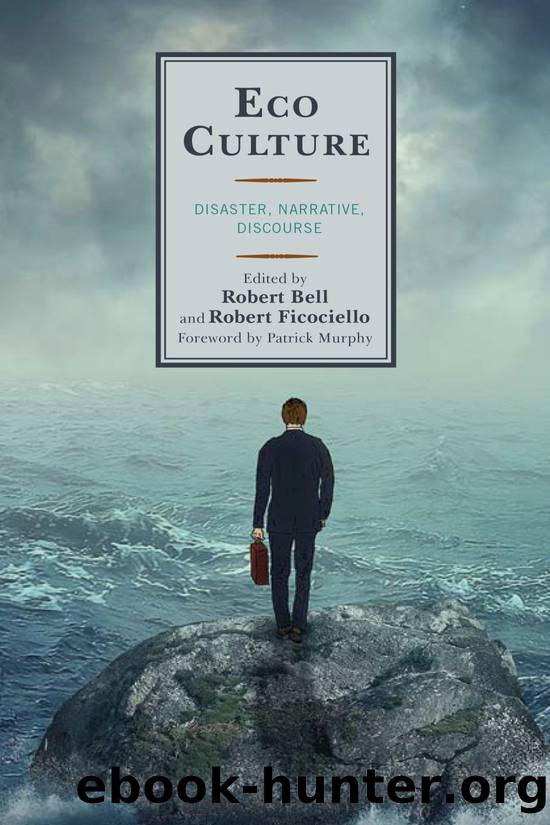
Author:Robert Bell,Robert Ficociello
Language: eng
Format: epub
Publisher: Lexington Books, a division of Rowman & Littlefield Publishers, Inc.
Part II
REMEDIATION
Chapter 7
âThe Missing Element is the Human Elementâ
Ontological Difference and the World-Ecological Crisis of the Capitalocene
Kirk Boyle
The over 1,600 pages of Kim Stanley Robinsonâs award-winning Mars Trilogy (1993â1996), the epic tale of the colonization and terraforming of the red planet by that peculiar hominid from Earth that calls itself Homo sapiens, begins with a description of Mars:
Mars was empty before we came. Thatâs not to say that nothing had ever happened. The planet had accreted, melted, roiled and cooled, leaving a surface scarred by enormous geological features: craters, canyons, volcanoes. But all of that happened in mineral unconsciousness, and unobserved. There were no witnessesâexcept for us, looking from the planet next door, and that only in the last moment of its long history. We are all the consciousness that Mars has ever knownâ¦. And so we came here. It had been a power; now it became a place.1
I was reminded of Robinsonâs work when reading McKenzie Warkâs Molecular Red: Theory for the Anthropocene. Wark devotes an entire chapter to the trilogy, âKim Stanley Robinson: The Necessity of Creation,â to decode what the science fictional terraforming of Mars might tell us about the possibilities of living in a new geological age ushered in by the activities of a singular species of great ape. As Wark somewhat offhandedly remarks, âPerhaps Earth is now a Mars, estranged from its own ecology.â2
I find this line of thoughtâEarth as not-Earth (at least as humans have known it for millennia)âcompelling, and I share Warkâs interest in the importance of theorizing utopia in a time of global environmental crisis caused by artificially created climate change. By setting the Mars Trilogy in the near future and in a nearby locale (at least with respect to outer space), Robinson invites his readers to entertain the utopian possibilities of the Anthropocene. I am drawn to Robinsonâs science fiction, however, for his representation of that which precedes what his former professor Fredric Jameson refers to as âthe desire called utopia.â3 In the opening section of the trilogy quoted from above, Robinson establishes the qualitative difference between a planet comprised of âmineral unconsciousâ and beings conscious of the existence of planets, let alone able to journey to them. What is known in philosophical circles as ontological difference arises when phenomenological beings transform a âblind powerâ into a âplace.â It is no accident that this brief sectionâlike several others in the trilogy which appear in italics; come from an unidentified narrator; and function as prefaces, interludes, or epiloguesâcarries the mythopoeic tone and metanarrative weight of a universal history imparted by one generation to the next. To become a place, a blind power requires a story, and the very existence of narrative betrays the presence of beings that are by their very essenceâbecause they have to tell a story about where they live in order to live thereâestranged from their home planet, whether they be occupiers of Mars or inhabitants of Earth. Science fiction narratives about the presence of humans on other planets reveal that we have always already been an alien species.
Download
This site does not store any files on its server. We only index and link to content provided by other sites. Please contact the content providers to delete copyright contents if any and email us, we'll remove relevant links or contents immediately.
| Anthropology | Archaeology |
| Philosophy | Politics & Government |
| Social Sciences | Sociology |
| Women's Studies |
Cecilia; Or, Memoirs of an Heiress — Volume 1 by Fanny Burney(32558)
The Great Music City by Andrea Baker(32018)
Cecilia; Or, Memoirs of an Heiress — Volume 2 by Fanny Burney(31956)
Cecilia; Or, Memoirs of an Heiress — Volume 3 by Fanny Burney(31941)
We're Going to Need More Wine by Gabrielle Union(19046)
All the Missing Girls by Megan Miranda(16026)
Pimp by Iceberg Slim(14506)
For the Love of Europe by Rick Steves(14121)
Bombshells: Glamour Girls of a Lifetime by Sullivan Steve(14075)
Talking to Strangers by Malcolm Gladwell(13370)
Norse Mythology by Gaiman Neil(13363)
Fifty Shades Freed by E L James(13240)
Mindhunter: Inside the FBI's Elite Serial Crime Unit by John E. Douglas & Mark Olshaker(9342)
Crazy Rich Asians by Kevin Kwan(9292)
The Lost Art of Listening by Michael P. Nichols(7506)
Enlightenment Now: The Case for Reason, Science, Humanism, and Progress by Steven Pinker(7313)
The Four Agreements by Don Miguel Ruiz(6765)
Bad Blood by John Carreyrou(6621)
Weapons of Math Destruction by Cathy O'Neil(6279)
